Bicarbonate

Need Help ?
If you couldn’t find the answer in the Bicarbonate calculator, please don’t hesitate to reach out to our team directly. We are always happy to help and will get back to you as quickly as possible!


If you couldn’t find the answer in the Bicarbonate calculator, please don’t hesitate to reach out to our team directly. We are always happy to help and will get back to you as quickly as possible!

Neonatal definitions are important in relation to categorization of infants into segments that carry a certain risk of associated morbidities. Newborns can be stratified based on Birth weight (BW), Gestational age (GA) and their relationship: Gestational age preterm newborns (< 37+0) term newborn (37+0 to 41+6) postterm newborn (> 41+6)…
Retinopathy of prematurity (ROP) is a vasoproliferative disorder (fibrovascular proliferation) of developing retina in preterm infants. It is characterised by disorganized growth of abnormal new blood vessels (=> hemorrhage) and fibrous tissue ( => contracted scar tissue causing retinal detachment). Incidence of ROP is inversely proportional to the gestational age (general ROP screening…

Birth injury is defined physical (mechanical) trauma of tissues and organs that is associated with birth (internal or external injury). Treatment is required for birth injury itself, as well as for the associated complications (perinatal asphyxia, hemorrhage and resultant anemia, hyperbilirubinemia, paresis, fractures). Risk Factors for Birth Injury Prematurity Instrumental birth (forceps,…

Apneas represent another important group of respiratory/ventilation dysfunctions in newborns (apart from perinatal asphyxia and respiratory distress syndrome). They are generally defined as a cessation of breathing movements and air flow for more than 20 seconds, thus often being accompanied by desaturation and bradycardia. Spontaneous breathing causes water in lungs to be resorbed into blood and…
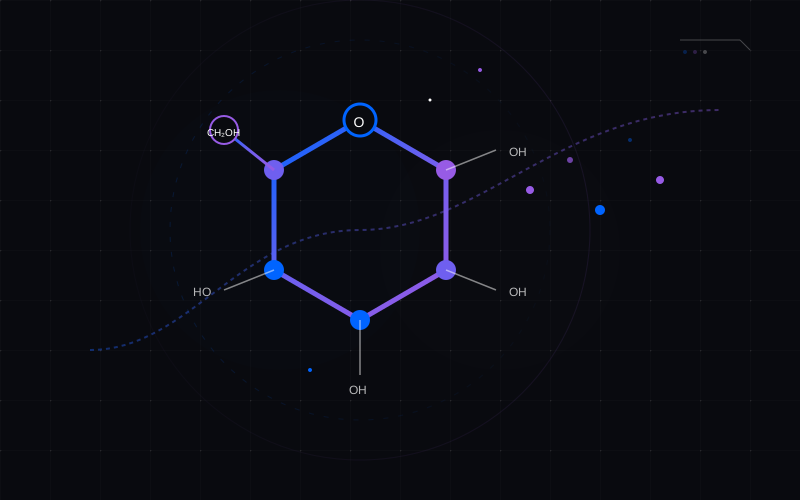
Glucose Infusion Rate (GIR) is the speed at which intravenous glucose is given to a newborn to treat hypoglycemia (low blood sugar) – standard starting target = 4-6 mg/kg/min.

Insulin is used for significant neonatal hyperglycemia if other key steps fail – lowering the intravenous glucose infusion rate, treating underlying condition (e.g. sepsis).
No products in the cart.